Author: petermo

  • Israel stations nuclear missile subs off Iran – Times

    “Three German-built Israeli submarines equipped with nuclear cruise missiles are to be deployed in the Gulf near the Iranian coastline” reports the Sunday Times. Israel allowed an interview with one of the captains, so it would seem that Israel is abandoning it’s nuclear ambiguity policy.  The Times reported a similar deployment last year;  and as this timeline shows Israeli officials have been giving off-the-record-briefings about their “strategic deterrent” since 1990 while publicly maintaining they will not be the first to introduce nuclear weapons to the Middle East.  This piece must be carefully timed to co-incide with the last days of the Nuclear non-proliferation Treaty five year review.

    Israel stations nuclear missile subs off Iran

    Three German-built Israeli submarines equipped with nuclear cruise missiles are to be deployed in the Gulf near the Iranian coastline.

    The first has been sent in response to Israeli fears that ballistic missiles developed by Iran, Syria and Hezbollah, a political and military organisation in Lebanon, could hit sites in Israel, including air bases and missile launchers.

    The submarines of Flotilla 7 — Dolphin, Tekuma and Leviathan — have visited the Gulf before. But the decision has now been taken to ensure a permanent presence of at least one of the vessels.

    The flotilla’s commander, identified only as “Colonel O”, told an Israeli newspaper: “We are an underwater assault force. We’re operating deep and far, very far, from our borders.”

    Each of the submarines has a crew of 35 to 50, commanded by a colonel capable of launching a nuclear cruise missile.

    The vessels can remain at sea for about 50 days and stay submerged up to 1,150ft below the surface for at least a week. Some of the cruise missiles are equipped with the most advanced nuclear warheads in the Israeli arsenal.

    The deployment is designed to act as a deterrent, gather intelligence and potentially to land Mossad agents. “We’re a solid base for collecting sensitive information, as we can stay for a long time in one place,” said a flotilla officer.

    The submarines could be used if Iran continues its programme to produce a nuclear bomb. “The 1,500km range of the submarines’ cruise missiles can reach any target in Iran,” said a navy officer.

    Apparently responding to the Israeli activity, an Iranian admiral said: “Anyone who wishes to do an evil act in the Persian Gulf will receive a forceful response from us.”

    Israel’s urgent need to deter the Iran-Syria-Hezbollah alliance was demonstrated last month. Ehud Barak, the defence minister, was said to have shown President Barack Obama classified satellite images of a convoy of ballistic missiles leaving Syria on the way to Hezbollah in Lebanon.

    Binyamin Netanyahu, the prime minister, will emphasise the danger to Obama in Washington this week.

    Tel Aviv, Israel’s business and defence centre, remains the most threatened city in the world, said one expert. “There are more missiles per square foot targeting Tel Aviv than any other city,” he said.

  • Israeli bomb sale to S. Africa – documentary evidence published

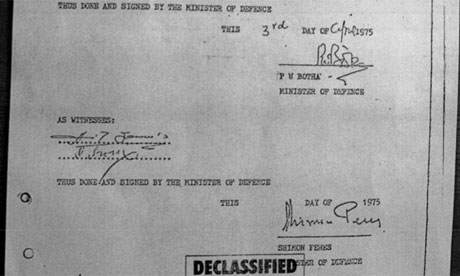
    The Guardian has published documentary evidence that Israel’s current President offered to sell nuclear weapons to South Africa’s apartheid regime in 1975.  Shimon Peres’  signature in the photo below will make it very difficult for western countries to continue pretending  that Israel does not have nuclear weapons  or that it is not a proliferation threat. A few days ago  prisoner of conscience and nuclear whistleblower   Mordechai Vanunu was again jailed by an Israeli court for speaking to foreigners.

    Revealed: how Israel offered to sell South Africa nuclear weapons

    Exclusive: Secret apartheid-era papers give first official evidence of Israeli nuclear weapons

    The secret military agreement signed by Shimon Peres and P W  Botha

    The secret military agreement signed by Shimon Peres, now president of Israel, and P W Botha of South Africa. Photograph: Guardian

    Secret South African documents reveal that Israel offered to sell nuclear warheads to the apartheid regime, providing the first official documentary evidence of the state’s possession of nuclear weapons.

    The “top secret” minutes of meetings between senior officials from the two countries in 1975 show that South Africa‘s defence minister, PW Botha, asked for the warheads and Shimon Peres, then Israel’s defence minister and now its president, responded by offering them “in three sizes”. The two men also signed a broad-ranging agreement governing military ties between the two countries that included a clause declaring that “the very existence of this agreement” was to remain secret.

    The documents, uncovered by an American academic, Sasha Polakow-Suransky, in research for a book on the close relationship between the two countries, provide evidence that Israel has nuclear weapons despite its policy of “ambiguity” in neither confirming nor denying their existence.

    The Israeli authorities tried to stop South Africa’s post-apartheid government declassifying the documents at Polakow-Suransky’s request and the revelations will be an embarrassment, particularly as this week’s nuclear non-proliferation talks in New York focus on the Middle East.

    They will also undermine Israel’s attempts to suggest that, if it has nuclear weapons, it is a “responsible” power that would not misuse them, whereas countries such as Iran cannot be trusted.

    South African documents show that the apartheid-era military wanted the missiles as a deterrent and for potential strikes against neighbouring states.

    The documents show both sides met on 31 March 1975. Polakow-Suransky writes in his book published in the US this week, The Unspoken Alliance: Israel’s secret alliance with apartheid South Africa. At the talks Israeli officials “formally offered to sell South Africa some of the nuclear-capable Jericho missiles in its arsenal”.

    Among those attending the meeting was the South African military chief of staff, Lieutenant General RF Armstrong. He immediately drew up a memo in which he laid out the benefits of South Africa obtaining the Jericho missiles but only if they were fitted with nuclear weapons.

    The memo, marked “top secret” and dated the same day as the meeting with the Israelis, has previously been revealed but its context was not fully understood because it was not known to be directly linked to the Israeli offer on the same day and that it was the basis for a direct request to Israel. In it, Armstrong writes: “In considering the merits of a weapon system such as the one being offered, certain assumptions have been made: a) That the missiles will be armed with nuclear warheads manufactured in RSA (Republic of South Africa) or acquired elsewhere.”

    But South Africa was years from being able to build atomic weapons. A little more than two months later, on 4 June, Peres and Botha met in Zurich. By then the Jericho project had the codename Chalet.

    The top secret minutes of the meeting record that: “Minister Botha expressed interest in a limited number of units of Chalet subject to the correct payload being available.” The document then records: “Minister Peres said the correct payload was available in three sizes. Minister Botha expressed his appreciation and said that he would ask for advice.” The “three sizes” are believed to refer to the conventional, chemical and nuclear weapons.

    The use of a euphemism, the “correct payload”, reflects Israeli sensitivity over the nuclear issue and would not have been used had it been referring to conventional weapons. It can also only have meant nuclear warheads as Armstrong’s memorandum makes clear South Africa was interested in the Jericho missiles solely as a means of delivering nuclear weapons.

    In addition, the only payload the South Africans would have needed to obtain from Israel was nuclear. The South Africans were capable of putting together other warheads.

    Botha did not go ahead with the deal in part because of the cost. In addition, any deal would have to have had final approval by Israel’s prime minister and it is uncertain it would have been forthcoming.

    South Africa eventually built its own nuclear bombs, albeit possibly with Israeli assistance. But the collaboration on military technology only grew over the following years. South Africa also provided much of the yellowcake uranium that Israel required to develop its weapons.

    The documents confirm accounts by a former South African naval commander, Dieter Gerhardt – jailed in 1983 for spying for the Soviet Union. After his release with the collapse of apartheid, Gerhardt said there was an agreement between Israel and South Africa called Chalet which involved an offer by the Jewish state to arm eight Jericho missiles with “special warheads”. Gerhardt said these were atomic bombs. But until now there has been no documentary evidence of the offer.

    Some weeks before Peres made his offer of nuclear warheads to Botha, the two defence ministers signed a covert agreement governing the military alliance known as Secment. It was so secret that it included a denial of its own existence: “It is hereby expressly agreed that the very existence of this agreement… shall be secret and shall not be disclosed by either party”.

    The agreement also said that neither party could unilaterally renounce it.

    The existence of Israel’s nuclear weapons programme was revealed by Mordechai Vanunu to the Sunday Times in 1986. He provided photographs taken inside the Dimona nuclear site and gave detailed descriptions of the processes involved in producing part of the nuclear material but provided no written documentation.

    Documents seized by Iranian students from the US embassy in Tehran after the 1979 revolution revealed the Shah expressed an interest to Israel in developing nuclear arms. But the South African documents offer confirmation Israel was in a position to arm Jericho missiles with nuclear warheads.

    Israel pressured the present South African government not to declassify documents obtained by Polakow-Suransky. “The Israeli defence ministry tried to block my access to the Secment agreement on the grounds it was sensitive material, especially the signature and the date,” he said. “The South Africans didn’t seem to care; they blacked out a few lines and handed it over to me. The ANC government is not so worried about protecting the dirty laundry of the apartheid regime’s old allies.”
  • US intel’s 2009 report on Iran

    The US director of National Intelligence recently  submitted his 2009_report on WMD to Congress.    The report  does not contradict the 2007 National Intelligence Estimate finding that Iran has no active nuclear weapons program… it finds:

    We continue to assess Iran is keeping open the option to develop nuclear weapons though we do not know whether Tehran eventually will decide to produce nuclear weapons.  Iran continues to develop a range of capabilities that could be applied to producing nuclear weapons, if a decision is made to do so.

    There are rumours that a new NIE on Iran  is in circulation but unlike the 2007 version, a declassified version will not be made public.

  • “Iran does have a nuclear weapons program”: Australian PM

    04 Feb 2010 KEVIN RUDD, PRIME MINISTER: We have exercised the powers under the act appropriately. Iran does have a nuclear weapons program. We are party to international obligations. We exercise those obligations because we believe we must play the role of a responsible international citizen.

    KAREN BARLOW: Liberal Senator Julian McGauran has got his own ideas, suggesting an international force bomb Iran.

  • Neutron initiator – smoking gun or forgery?

    The Times in London recently published a major  story about a document showing Iran is researching neutron initiators – smoking gun proof of a nuclear weapons program if it’s genuine.    Intelligence agencies and the IAEA have known about the document for years and are not sure if it is a fake.  NY Times story below:

    Nuclear Memo in Persian Puzzles Spy Agencies

    Published: December 15, 2009

    For many months now, American and European intelligence agencies have been trading theories about a spare, two-page document written in Persian that, if genuine, would strongly suggest that scientists in Iran were p

    But like so many pieces of evidence in the West’s confrontation with Tehran, the neatly written memorandum, laying out the next steps of a complex scientific process, raises as many questions as it answers.

    Intelligence officials say they have yet to authenticate the document, which describes research Iran would need to conduct on an advanced technology to detonate a nuclear weapon, if it was to develop one. Even if the paper is genuine, they say, it is unclear if it provides new insights into the state of Iran’s weapons research.

    Diplomats raised the possibility that the publication of the memo on The Times of London Web site late Sunday could be part of an effort to raise international alarm over Iran’s intentions or progress in developing nuclear weapons capacity.

    “This information’s been sloshing around for well over a year,” said one American official, who insisted on anonymity because he was discussing sensitive intelligence information. “It’s not new to the intelligence people. They’ve taken account of it. If, in fact, the document’s on the level, it shows the Iranians at some point were interested in testing an initiator. That’s not a warhead or the core of a bomb. It’s another reminder — as if one were needed — that the Iranians have a lot of explaining to do when it comes to things nuclear.”

  • Brazil’s new uranium enrichment and old bomb

    Brazil’s new uranium enrichment plant, refusal to sign an IAEA Additional Protocol, current military research on nuclear weapons designs, and its new nuclear submarines should clearly be seen as having nuclear weapons  implications as strong or stronger than Iran’s nuclear plans. The enrichment technology was developed as part of Brazil’s  secret nuclear weapons program, abandoned in 1990.  Coincidentally, Brazil is the US’s first choice for a new permanent seat on the UN Security Council;    currently all permanent members are the NPT’s nuclear weapons states, and vice-versa.

    Uranium enrichment: In 2006, an industrial enrichment plant of 120,000 SWU/yr  opened in Resende, near Rio, to produce 3.5% enriched uranium for Brazil’s 2 reactors and nuclear submarines, with future plans for 200,000 SWUs by 2015.  The Brazilian  nuclear company, INB  says ‘The big breakthrough is that in future we do not depend on external services for an important technology”, and that  economic advantages would be minor ($25m per year).

    Before this, uranium was sent to Camenco for conversion to UF6 gas, which was then sent to Urenco for enrichment, and returned as UF6 to Brazil for fuel fabrication.

    Brazil’s  old nuclear weapons program: Globalsecurity.org has an extensive piece on the Brazilian Navy’s weapons “Parallel program” which started in 1975 with jet-nozzle enrichment technologies from  Germany:

    West Germany did not require IAEA safeguards, and following the 1975 agreement Brazil transferred technology from its power plant projects to a secret program to develop an atom bomb… the secret program was started in 1975 and eventually came to be known publicly as the Parallel Program. In the beginning of the eighties, the Navy Nuclear Parallel Program began to expand, especially after the uranium enrichment process named jet nozzle… turned out to be infeasible.   During the decade, the civilian nuclear program lagged behind. Meanwhile, parallel research for obtaining fuel cycle know-how was intensified…

    In 1987, José Sarney (president, 1985-90) announced that Brazil had enriched uranium successfully on a laboratory scale to 20 percent. At that time, some observers predicted that Brazil would have a nuclear-weapons capability by the turn of the century…

    President Fernando Collor de Mello took bold steps to control and restrict Brazil’s nuclear programs… [in October 1990] …  he formally exposed the military’s secret plan to develop an atom bomb.

    In April 2004 the Brazilian government and International Atomic Energy Agency nuclear inspectors were at odds over inspections of an under- construction, uranium- enrichment facility near Rio de Janeiro [Resende]. Brazil refused to allow IAEA inspectors to see the facility’s equipment in order to protect proprietary information. They insisted that the facility will only produce low-enriched uranium, which is legal under the Nuclear Nonproliferation Treaty, so long as it is safeguarded. They also refused to fully cooperate with the IAEA’s investigation into the nuclear black market operated by Pakistani scientist A.Q. Kahn.

    In June 2004 Brazil’s Ambassador reiterated his country’s intent to limit the access of the International Atomic Energy Agency to Brazil’s uranium enrichment plant. One rationale he used was Brazil’s unhappiness that the Bush administration would consider using nuclear weapons against non-nuclear countries.

    Colin Powell hoped in 2004 that Brazil  “will see the wisdom” of signing an  “Additional Protocol” to expand the IAEA’s authority to detect clandestine nuclear programs, but as of 2010 Brazil has not  (see the IAEA list here and note that Iran signed  its Additional Protocol in 2003 but later stopped implementing it in protest at what it said was denial of its NPT rights by Western powers).

    2009 research on nuclear weapons:

    In Septmber 2009, the Brazilian army’s Miltary Institute of Engineering  published a  doctoral paper saying it had worked out the mathematical principles of a weapon similar to the ubiquitous W89 nuclear warhead used in US and UK missiles.

    According to the article’s Google transation:  the researcher, Dalton Ellery Girão Barroso “confirmed that Brazil already has knowledge and technology, if you want to develop the atomic bomb. ‘No need to make the bomb. Just show that you know’  ”

    Barroso  also published a book helpfully entitled “The physics of nuclear weapons”. As the Federation of  American Scientists report:

    According to the Jornal do Brasil… the IAEA “wanted the book to be recalled” and demanded more information on the author’s work.  The government of Brazil refused to censor the book and rejected what it described as IAEA interference.

    “One presumes that many of the specific results presented here have never been published in the open scientific literature,” he [Barroso] wrote in the Preface to the book.  “However, such results are based on well-known physical and mathematical models.”

    Brazil’s nuclear submarines: As far as I know, the only countries with nuclear submarines originally built them to deploy nuclear weapons safely underwater as survivable “deterrents”.   (Israel does the same, but with modern fuel-celled subs) .  India is buying one from Russia.  Brazil has not been at war for over a century, so a June 2009 article in the US Naval Institute’s UNSI Proceedings asks “Why does Brazil need nuclear submarines?”.  A long and interesting article, it  concludes

    The National Defense Strategy the government of Brazil released on 17 December 2008 provides little plausible military justification for the recently accelerated nuclear-powered submarine project.

    The long UNSI article politely never refers to Brazil’s past secret bomb program; oddly enough, it says the opposite:  “Brazil has a long-established, responsible, and peaceful nuclear power program”, and amongst the possible justifications it analyses, it does not consider the submarines could be housing for nuclear missiles.  It points out “the  navy had begun a program in 1979 to build a dual-use nuclear reactor suitable to propel a submarine and generate electricity for civilian consumers”.  It does not mention the navy simultaneously started a bomb program.   Sarkozy has agreed to provide designs for a nuclear submarine hull.

    The US Naval Institute  reports that Brazil’s president Lula said of the subs in December 2008 that  “in a few years, Brazil will be one of the select group of nations that possess this indispensable capability for effective deterrence”.  This form of words must be worrying:  military analysts don’t consider a handful of extremely expensive nuclear attack submarines much of a deterrent  – on the other hand, nuclear-armed submarines are always referred to as deterrents.  Even more worryingly  Brazil is anyway buying state of the art conventional-powered submarines for the attack-submarine role, and has no conceivable naval rival that could be any threat.

    Security Council seats: Brazil, India, Japan and Germany are the main candidates for new permanent member seats on an expanded UN Security Council.   Other South American countries are not keen on Brazil’s taking up the ‘South American’ seat;   and India’s candidacy is backed by its huge population and unofficial nuclear weapons status.  Japan has no declared bomb programme, but it is clear to everyone that they have done enough research to build one in a matter of weeks.   If Brazil were to follow suit and  develop a clear bomb-capacity and a nuclear-powered-submarine delivery platform, its UN candidacy would be considerably enhanced.

  • Bolton suggests Israeli nuclear attack on Iran

    “So we’re at a very unhappy point — a very unhappy point — where unless Israel is prepared to use nuclear weapons against Iran’s program, Iran will have nuclear weapons in the very near future.” So said  Bush’s former UN ambassador  John Bolton at the University of Chicago.

    “Bolton’s use of the n-word is, I believe, new for him, and marks a significant rhetorical escalation from the hawks” says Daniel Luban in this  IPS story.

    Bolton suggests nuclear attack on Iran

    By Daniel Luban

    This Friday, the American Enterprise Institute will host an event addressing the question “Should Israel attack Iran?” The event includes, among others, Iran uberhawk Michael Rubin and infamous “torture lawyer” John Yoo, but the real star is likely to be John Bolton, the former U.N. ambassador whose right-of-Attila views left him an outcast even within the second Bush administration. (Bolton was eventually forced out when it became clear that he would be unable to win Senate confirmation for the U.N. post.)

    If Bolton’s recent rhetoric is any indication, his AEI appearance may accomplish the formidable feat of making Michael Rubin sound like a dove. Discussing Iran during a Tuesday speech at the University of Chicago, Bolton appeared to call for nothing less than an Israeli nuclear first strike against the Islamic Republic. (The speech, sponsored by the University Young Republicans and Chicago Friends of Israel, was titled, apparently without a trace of irony, “Ensuring Peace.”)

    “Negotiations have failed, and so too have sanctions,” Bolton said, echoing his previously-stated belief that sanctions will prove ineffectual in changing Tehran’s behavior. “So we’re at a very unhappy point — a very unhappy point — where unless Israel is prepared to use nuclear weapons against Iran’s program, Iran will have nuclear weapons in the very near future.”

    Bolton made clear that the latter option is unacceptable. “There are some people in the administration who think that it’s not really a problem, we can contain and deter Iran, as we did the Soviet Union during the Cold War. I think this is a great, great mistake and a dangerously weak approach…Whatever else you want to say about them, at least the Soviets believed that they only went around once in this world, and they weren’t real eager to give that up — as compared to a theological regime in Tehran which yearns for life in the hereafter more than life on earth…I don’t think [deterrence] works that way with a country like Iran.”

    While Bolton coyly refused to spell out his conclusion, the implications of his argument were clear. If neither negotiations, nor sanctions, nor deterrence are options, then by his logic the only remaining option is for “Israel…to use nuclear weapons against Iran’s program.”

    Of course, it is nothing new for Bolton and his neoconservative allies to threaten an Israeli strike against Iran. But Bolton’s use of the “n-word” is, I believe, new for him, and marks a significant rhetorical escalation from the hawks. An Israeli strike, nuclear or otherwise, without U.S. permission remains unlikely. But as it often the case, I suspect that Bolton’s intention is less to give an accurate description of reality than it is to stake out positions extreme enough to shift the boundaries of debate as a whole to the right.


  • Obama Reafirms He Will Keep Israel’s Nukes ‘Secret’

    For  declassified top secret 1969 documents about the original US decision to keep Israel’s nukes secret, see this post

    Obama Reaffirms He Will Keep Israel’s Nukes ‘Secret’

    President Vows to Keep World’s Worst-Kept Secret

    from Antiwar.com

    by Jason Ditz, October 02, 200

    Following up on assurances he made in May, President Obama has reportedly ‘reaffirmed’ a secret understanding whereby he will not reveal the existence of Israel’s widely known nuclear arsenal, nor will he pressure Israel to join the nuclear Non-Proliferation Treaty (NPT).

    Though Israel has often, albeit accidentally, publicly revealed that they have nuclear weapons, the United States officially has followed a “don’t ask, don’t tell” policy with the arsenal, the only one of its kind in the Middle East.

    The revelation is likely to cause some international consternation, particularly since President Obama championed a bill at the UN Security Council only last week demanding that all the nations of the world to join the NPT.

    Despite this call, the US publicly and angrily rejected a resolution calling for Israel to join the NPT only a week before that, saying that it was “unfair.” Israel has ruled out ever opening up its arsenal to the same international scrutiny as NPT signatories do.

  • Australia’s uranium enrichment goes commercial – SILEX

    Few people realise  that revolutionary Australian laser technology  is on the verge of  producing enough enriched uranium to supply all of Austalia’s electricity needs, under licence in the US.

    For years SILEX have semi-secretly developed laser uranium enrichment at Lucas Heights in Sydney, and their “test loop” commercial prototype is already operating in America, under an exclusive licence agreement with Global Laser Enrichment (GLE).   Results are so encouraging they applied to US nuclear regulators in 2009 to build a full-scale plant capable of producing 6 million SWUs of enriched uranium  Roughly 100,000 SWUs will run a 1,000 MW nuclear reactor for a year – the annual output will thus run about 50 large nuclear power plants.  NRC approval is expected in 2012, construction may begin before that, and in 2013 a major source of  US fuel will disappear when the downgrading  of old Soviet high-enriched warheads finishes – as General Electric helpfully points out.

    Global Laser Enrichment is a business venture of  General Electric (51%), Hitachi (25%) and Canada’s  Camenco (24%)

    Extracts from SILEX’s 2009 Uranium Enrichmen update

    The Test Loop is designed to validate the commercial feasibility of the SILEX Technology and advance the design of the equipment, facility and processes for the planned commercial production facility.  GLE anticipates  obtaining sufficient data from the Test Loop by the end of 2009 to decide whether to proceed with plans for a full-scale commercial enrichment facility.

    Progress with Commercial Production Facility Plans: A separate team continues to progress plans for a commercial production facility in parallel with Test Loop activities. If a decision is made to proceed with a commercial facility, GLE plans to co-locate the facility on the site of the existing nuclear fuel manufacturing facilities of Global Nuclear Fuel and the new plants and services business of GE Hitachi Nuclear Energy, headquartered in Wilmington N.C. Subject to the decision to proceed, the GLE commercial production facility would have a target capacity of 3.5 million to 6 million separative work units (SWU’s).  A SWU is a unit measuring the energy used to enrich uranium, which is then fabricated into fuel assemblies for nuclear power plants.

    As previously disclosed (refer ASX release 31/7/09), GLE is expected to refine its projected schedule at  the end of 2009.  If the decision is made to proceed with the commercial production facility, the schedule would be determined in part by the licensing process, expected to take approximately 30 months from August 17, 2009, the date that the U.S. Nuclear Regulatory Commission (NRC) formally accepted the license application submitted by GLE.  Accordingly, GLE would expect the timing for receiving an NRC license to be the end of 2011 or the beginning of 2012.  Subject to proceeding,  GLE could begin construction of  certain ancillary facilities with NRC permission  including site preparation,  prior to receiving the license. More detailed information on the schedule is expected to be available from GLE in late 2009.

  • North Korea says uranium bomb near completion

    The NORKS say they are about to  build nuclear weapons using  highly enriched uranium, in addition to  the plutonium  bomb which they tested recently.  They say they are on the “completion stage” of uranium enrichment capacities, but I think that could take some  years;   so this could be a negotiating stategy.

    Another article extract:

    North Korea says uranium  program near completion

    SEOUL, South Korea – North Korea said Friday it is on the threshold of mastering a new way of building atomic bombs, pressuring the United States to agree to direct negotiations or see the communist regime become a greater nuclear risk.

    Pyongyang’s claim to have succeeded in experimental uranium enrichment — an easier way to make nuclear weapons — raises concerns that North Korea may add uranium-based weapons to enlarge its stockpile of atomic bombs made from plutonium.

    North Korea also said it is continuing to weaponize plutonium.

    via North Korea says uranium program near completion – Yahoo News.